

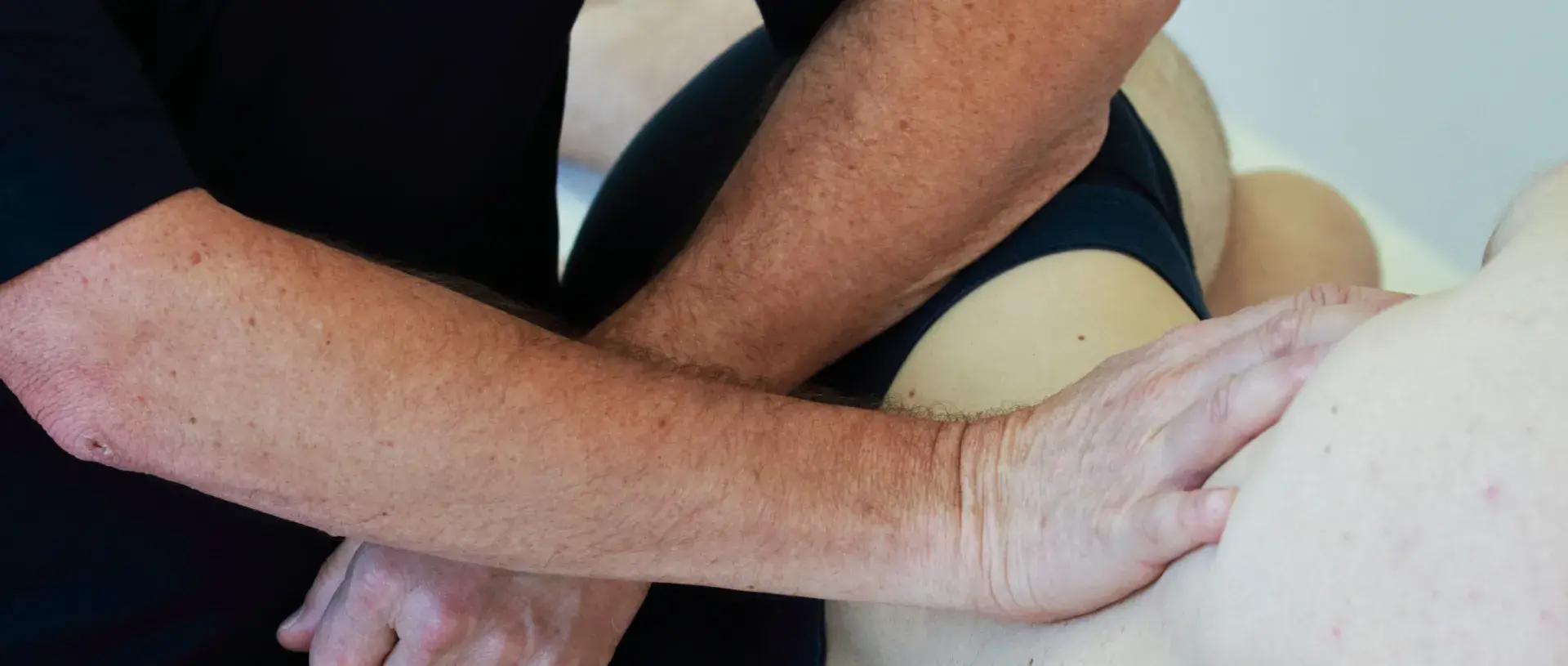
It's a familiar scene in any Rolfing® practice. Someone walks in with persistent pain and walks out moving more freely, breathing more easily, feeling better. What's actually happening here? To make sense of it, we have to start with a more basic question: what is pain?
Most people carry an intuition that pain is a faithful report on the state of our tissues. It hurts because something is damaged, so relief means fixing the damaged part. This is the biomedical model of pain, and many modalities have leaned on it to explain what they do.
Decades of pain research tell a more complex story. Pain is not a direct readout of tissue damage. It can be better understood as a warning system whose job is to protect the body. Tissue damage can certainly underlie pain, but the relationship is looser and more complex than it appears, and there is far more to pain — especially chronic pain — than damage alone.
How do we know?
The clearest evidence that pain cannot be explained by tissue damage alone comes from examples where pain and damage diverge.
Consider phantom limb pain, where a person feels pain in the missing limb. Not in the stump, but in thin air. This is a case where there are no tissues left to be damaged, yet the pain is real. Stranger still, it can sometimes be eased by treatments like mirror therapy, which change how the brain represents the missing limb without ever touching the body. If pain lived in the tissues, none of this would be possible.
Or consider the spine. A bulging disc on a scan looks like an obvious cause of pain, and often it's treated as one. But the spine changes with age, usually without consequence. Among people with no neck pain at all, around 88% have disc bulges. Structural changes and pain do not always correspond in a simple or predictable way.
This is also why, for low back pain, early imaging often can do more harm than good. Scans correlate poorly with pain and ordering them early can lead to worse outcomes by sending people on a hunt for a structural cause that may have nothing to do with the pain.
You don't need an injury to see this divergence. Our experience of pain shifts from hour to hour with our mood, our stress, how distracted or absorbed we are — rising and fading while the tissues underneath stay exactly the same.
If not in the body, then what?
So if pain isn't a faithful signal rising up from the tissues, what is it? Pain is now understood as a protective process. While tissue conditions can be an important part of the picture, pain reflects the nervous system's interpretation of a much broader range of information related to protection and survival. Most of the time, this system is functional and highly beneficial. The rare people born unable to feel physical pain, for example, tend to live considerably shorter lives.
None of this means you can think your way out of pain. But it does mean the brain draws on an enormous range of information, from anatomical structures and physiology to behavioral and environmental aspects, when it generates the experience of pain. That is why factors like attention, expectation, emotion, and stress all measurably shift our experience of pain.
When the system has a life of its own
This protective system can also go awry. In the shift from acute to chronic pain, the warning system may become increasingly sensitized and can become less closely related to the current state of the tissues. Chronic pain involves different mechanisms, and even different brain regions, than acute pain. The pain system, you might say, takes on a life of its own.
Once it does, searching for a damaged structure to blame can frame the whole problem in a counterproductive way. It often motivates a hunt for an anatomical culprit while the factors actually driving the pain (and there are usually several) go unaddressed.
What this means for treatment
For practitioners, this reframing is genuinely useful. Because the link between damage and pain is often more complex, and because so many other factors feed into chronic pain, different people may need different strategies. Understanding the specific factors shaping a person's pain provides insight into the client’s experience and can help Rolfers® match their approach to their client.
It also reframes our understanding of how Rolfing Structural Integration might help. Alongside changes to tissues like fascia and muscle, the work may also influence the broader physiological and perceptual processes involved in pain — and appreciating that wider view helps practitioners understand, and explain, their own results. Speaking the language of modern pain science makes it easier to build rapport, to help clients understand their own pain (which on its own tends to improve outcomes), to interface with mainstream care, and to recognize when to refer.
With roughly one in five adults living with chronic pain, and pain one of the most common reasons people seek out a Rolfer®, this is not a niche concern.
Pain Science for Rolfers®
We built an eight-week course, Pain Science for Rolfers and Structural Integrators, to bridge the gap between the biomedical model and what current pain research supports. It offers a broad, up-to-date understanding of pain and closes by examining current theories and research concerning the mechanisms through which Rolfing Structural Integration can support people experiencing pain.
Bios
Tim Cacciatore, PhD, studies the neuroscience of postural tone and the mechanisms underlying somatic methods.
Mari Hodges, MScMed, brings advanced training in pain management and years of clinical work with people in chronic pain.
As certified Alexander Technique teachers, we share hands-on experience working with people in pain. We built this course to bring modern pain science into conversation with Rolfing, translating current research into a working framework that fits the realities of Structural Integration practice.
To keep the material pertinent to the Rolfing perspective, we have developed it in collaboration with the European Rolfing Association and Certified Rolfing® Instructor Jakob Reichardt.
Who is this course for?
Rolfers, Structural Integrators, Rolfing students, fascia therapists, myofascial release practitioners, and other bodywork professionals interested in contemporary pain science.
Course starts: 27 October 2026
Further information and registration
Learn more about Rolfing® Structural Integration.
Find a Rolfer® or Rolf Movement™ Practitioner near you
More information on how to become a Certified Rolfer®.
Want to know more?
Sign up for our newsletter and receive regular information about Rolfing® Structural Integration.


